
Why partner with WAYSTEK?
Beyond products—we cover design, delivery, and long-term operations as your technical partner.
We build on embedded AI with WaysCogniShield Engine (WCS)—the Ways product line plus CogniShield semantics for cognitive, on-device malware & intrusion defense—plus model deployment and custom HW/SW integration for connected products and industrial systems.
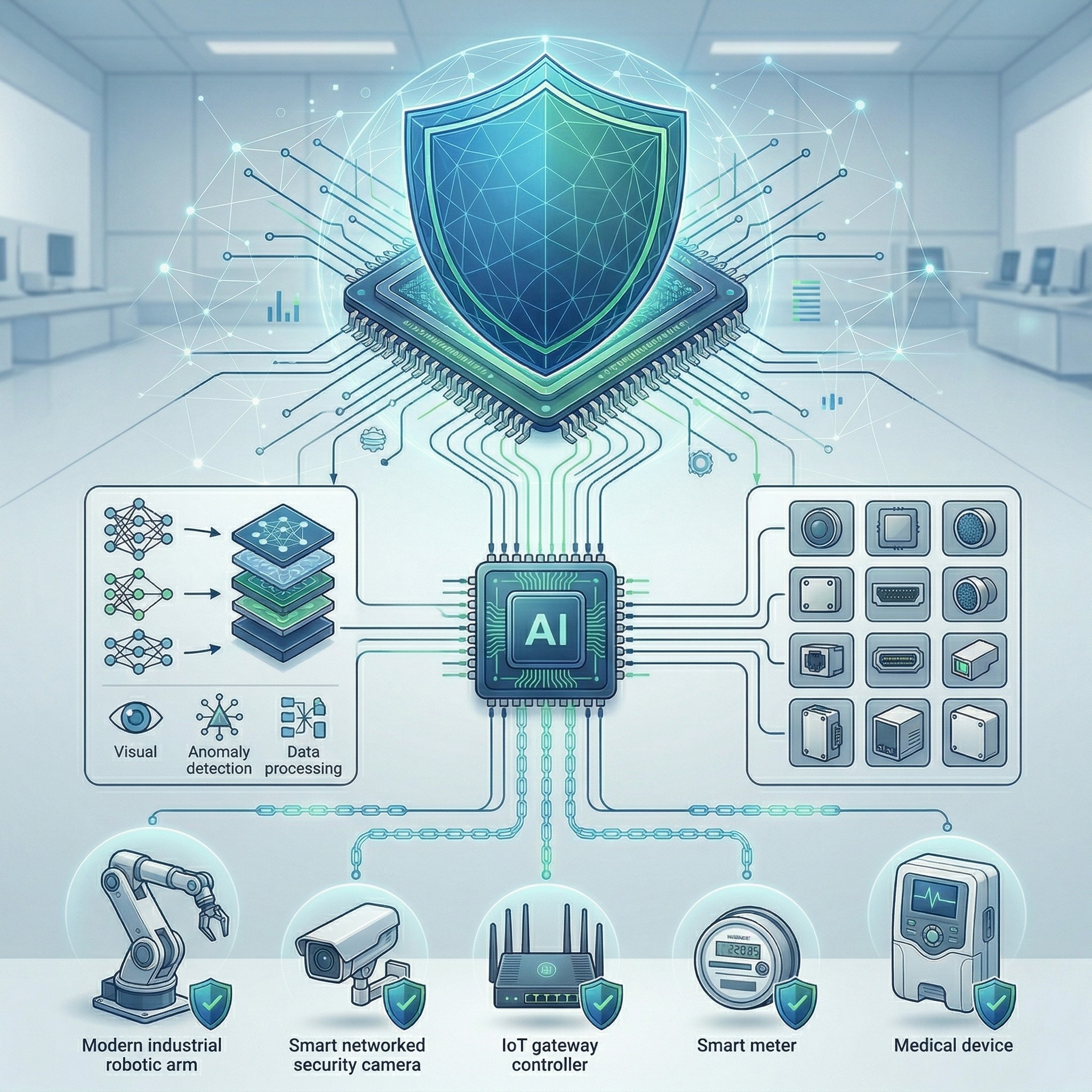
Embedded engineering and AI-native security for the connected world
Founded in 2014, we focus on embedded systems, AI-driven security, and tailored HW/SW integration. We place protection on the device—IoT, industrial, and critical endpoints included.
Our engineers average 15+ years across x86/ARM, firmware, drivers, integration, and on-device AI—from PoC through production and sustainment.
We believe security starts at the edge: real-time detection and defense without giving up performance—aligned with zero-trust thinking.
Core capabilities
WCS-class engine integration and on-device deployment.
BSP, drivers, and platform bring-up for your SoC and form factor.
From hardware choices and firmware to cloud services and apps.
Back-office, toolchain, and operations systems built to spec.
Threat modeling, hardening roadmaps, and compliance-oriented improvements.
Beyond products—we cover design, delivery, and long-term operations as your technical partner.
WaysCogniShield Engine (WCS) extends the Ways brand with CogniShield (cognitive protection) semantics—our lightweight inference stack for constrained devices: sub-millisecond-class threat checks on Cortex-A class SoCs, under ~8 MB footprint, fully offline-capable without relying on the cloud for analysis.
From PCB review, BSP, and drivers through apps, backends, and mobile clients—one team from chip to cloud, cutting vendor coordination overhead and integration risk.
WCS and integration programs are structured around PoC, pilot, and production milestones so teams can control risk and schedule; depth of integration and test coverage follow your platform, compliance, and operational needs.
Technical inquiries answered within 24 hours; agile PoCs and iterative scope—for startups’ MVPs or enterprise integration programs alike.
Industrial, consumer, medical, smart home, fintech, and more—broad exposure helps us map requirements to the right architecture faster.
Next-gen endpoint protection—on-device AI immunity for every connected product
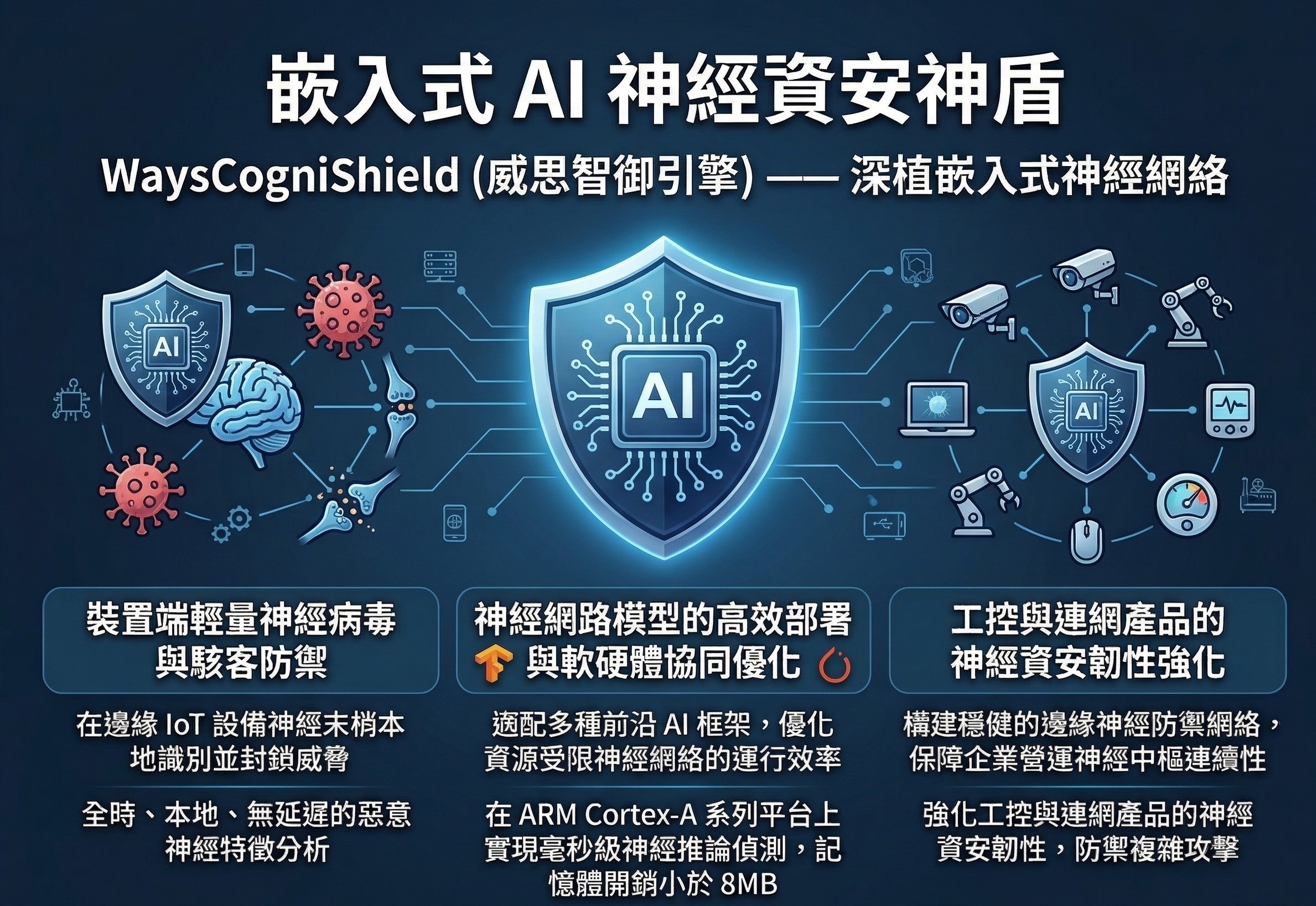
IoT growth makes embedded targets prime for attackers. Legacy endpoint stacks are often too heavy for constrained SoCs. WaysCogniShield Engine (WCS) pairs compact neural nets with a clear mission: robust on-device cybersecurity at the endpoint without mandatory cloud dependency.
 Click to enlarge
Quantization & pruning keep models under ~8 MB; on Cortex-A53 @ 1 GHz target <10 ms scan latency and <5% CPU during checks.
Beyond signatures—behavior and anomaly models catch zero-day malware, ransomware, rootkits, and IoT-specific payloads.
Runs air-gapped for OT, healthcare, and defense-style networks; supports secure OTA model refresh when allowed.
ARM Cortex-A/M, RISC-V, x86; Embedded Linux, FreeRTOS, Zephyr, and more—drop into existing BSPs quickly.
Fleet dashboards, alerting, policy push, log analytics, and compliance reporting for enterprise SOC workflows.
C/C++ SDK and REST hooks for allow/deny lists, scan policies, and automated response playbooks.
On supported embedded Linux platforms, WCS-related offerings can combine eBPF to run verified, in-kernel sandboxed programs for telemetry and policy hooks—improving visibility and timely defense at the endpoint (availability depends on kernel/version, configuration, and integration scope).
Three pillars: embedded AI security, custom software, and full-stack integration
On-device AI protection tuned for memory- and CPU-limited SoCs—proactive detection at the silicon edge.
Requirements through sustainment—desktop, web, and mobile, with AI-enabled backends where needed.
From proof-of-concept to production-ready embedded stacks plus architecture and security reviews.
Engineering foundations for secure, AI-ready products
Proprietary lightweight engine blending ML and behavioral analytics, optimized for embedded footprints.
Bootloader through apps—BSP, kernel, and userspace on leading SoCs and RTOS/Linux combos.
Systems code, APIs, web frontends, and mobile—agile delivery with production quality gates.
MQTT, BLE, Zigbee, CAN, Modbus, and more—reliable device meshing with secure transports.
Cloud-native patterns, HA services, and data pipelines for AI training and fleet telemetry.
IoT/embedded assessments aligned with IEC 62443, NIST CSF, and automotive workflows.
Representative scenarios and design directions for on-device protection with WCS. Narratives and figures are illustrative; actual results and any certifications or regulatory outcomes depend on your product, test scope, and the authorities—not on WAYSTEK holding a specific third-party certification.
Manufacturing lines running hundreds of Cortex-A7 gateways faced ransomware and data-exfil risk. WCS deployed inline without downtime.
Omnichannel stock, ERP, Android POS, and RFID readers unified on private cloud.
Practices informed by IEC 62443-style guidance: reviews, threat modeling, secure boot, and embedded endpoint controls to support FDA cybersecurity documentation themes—without implying WAYSTEK or the device has passed a specific agency certification.
Multi-source data fusion, predictive models, and automated backtesting with risk dashboards for institutional desks.
CM4-class hub bridging Zigbee, BLE, and Wi-Fi with Android control apps and voice surfaces.
Automotive Linux hardening, CAN protections, and secure OTA for Tier-1 IVI programs.
Smart cameras and edge NVRs in multi-site retail faced malware and exfiltration risk. WCS on camera firmware and recording hosts adds on-device detection and anomaly alerts.
Multi-protocol edge gateways linking PLCs, sensors, and MES faced lateral-movement risk. WCS on ARM gateways enables offline inspection, policy enforcement, and SOC-aligned alerting.
Always-on Android/Linux panels in retail and transit are common entry points. WCS is baked into images and update flows with app allow-listing and behavior monitoring.
Book a free architecture review with our AI security engineers.
Contact us15+ years average depth across embedded, AI, and enterprise delivery
Embedded and AI-security background with 15+ years on ARM platforms; leads industrial integration programs and WCS go-to-market.
Digital transformation advisory and B2B brand building for global technology partnerships.
Embedded Linux, BSP, and model optimization—architect of WaysCogniShield Engine (WCS) and security integration playbooks.
Finance, compliance, and capital planning for high-growth deep-tech operations.
Answers about embedded AI security, delivery, and support
Today we target ARM Cortex-A5/A7/A53/A55/A72-class SoCs and leading RISC-V cores with Embedded Linux (kernel 4.x+) or FreeRTOS-class RTOS. Minimum guidance: ~512 MB RAM and 1 GHz CPU—tighter footprints available with custom tuning. Send a BOM for a free fit-gap review.
Typical SDK hook-in needs 2–4 weeks for a PoC; production hardening (test + tuning) lands around 2–3 months. Docs, samples, and named support lower friction—custom scopes quoted separately.
Discovery → technical sizing → proposal. Expect a 1–2 h workshop, then a written plan within ~3–5 business days covering scope, timeline, and resourcing. Engagements can be fixed-bid milestones or time & materials, tuned to scope and release cadence.
Architecture reviews, SoC/memory/radio selection, software stack planning, security design reviews, performance profiling, and manufacturing readiness—hourly or retainer.
Yes—business-hour, follow-the-sun, and dedicated-SLA tiers. WCS subscriptions include model and threat-intel refresh channels to keep edge defenses current.
Embedded Linux (Yocto, Buildroot, OpenWRT), Android/AOSP, FreeRTOS, Zephyr, QNX, VxWorks, plus bespoke BSP and image pipelines.
Reach our AI security and integration engineers
Search @waystek (include the @ symbol)
Mon–Fri 09:00–18:00 (local)
Email / LINE: reply within 24 h
Emergency escalation available by arrangement
